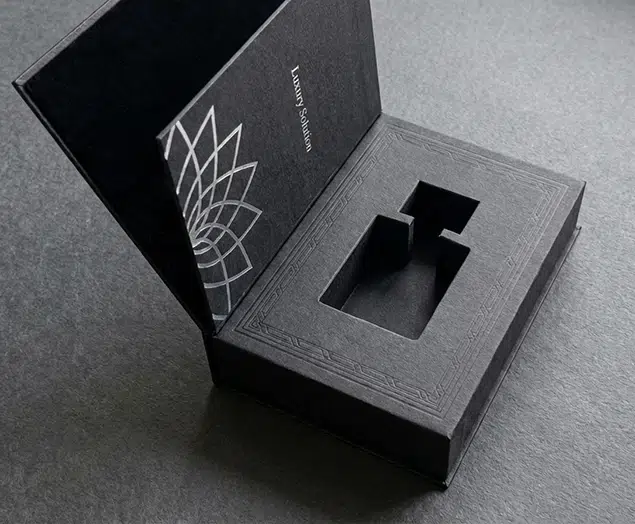


1. Foams and Sponges: Ultimate Shock Absorption
These materials utilize internal cellular structures to absorb kinetic energy and impact forces, making them the premier choice for fragile goods and high-value items.
1.1 EVA Inserts
EVA is the dominant insert material for premium rigid boxes. It boasts a dense, firm texture with a customizable Shore hardness typically ranging from 38 to 70 degrees. Its greatest advantage lies in its extreme fabrication flexibility.EVA can be precisely die-cut or CNC-routed to create complex, custom cavities that grip the product tightly. To elevate the visual and tactile presentation, EVA surfaces are frequently “flocked” (laminated with a layer of soft velvet or suede-like material).
- Pros: Exceptional shock absorption and crush resistance; clean, sharp cut edges; moisture and static resistance; highly durable for repeated product removal and insertion.
- Cons: Due to residual foaming agents, fresh EVA emits a noticeable odor requiring off-gassing time in a ventilated space; it is not rapidly biodegradable; unit and tooling costs are relatively high.
- Ideal Applications: Premium spirits, precision instruments, luxury watches, high-end cosmetic gift sets.


1.2 XPE Foam Liner
XPE is widely considered the premium tier of foam materials. Manufactured from virgin polymer granules, it features an independent closed-cell structure. Compared to EVA, XPE is virtually odorless and meets stringent environmental and safety standards. Its surface is incredibly smooth and fine, boasting superior resilience that immediately springs back after compression.
- Pros: Eco-friendly and odorless; refined aesthetic texture; excellent water and chemical resistance; maintains shape permanently.
- Cons: Carries a premium price tag; slightly more complex to fabricate than standard open-cell sponges.
- Ideal Applications: Export-grade hardware tools, premium tea canisters, infant care products, high-end glassware.


1.3 EPE Liner
EPE is an extruded, non-cross-linked closed-cell foam. It is ubiquitous in large appliance packaging and protective shipping mailers. Characterized by large cellular bubbles, it is lightweight, relatively soft, and typically white. While basic in appearance, EPE can be laminated with films, velvet, or specialty paper to improve its presentation.
- Pros: Highly cost-effective; excellent cushioning properties; non-toxic and odorless.
- Cons: Can look cheap in raw form; low density means it may permanently compress and thin out under prolonged heavy loads; cutting edges can be slightly jagged.
- Ideal Applications: Anti-static packaging for electronics, fresh produce transit boxes, heavy appliance cushioning.


1.4 Polyurethane Sponge Liner
Sponges feature a high-porosity, open-cell structure that makes them exceptionally soft. Unlike the rigid grip of EVA, sponge provides a “hugging,” soft-cushion effect. It is easily dyed into custom colors and readily accepts high-end silk or velvet laminations.
- Pros: Extremely soft with rapid rebound elasticity; moderately priced; highly effective against surface scratching.
- Cons: Lacks structural rigidity, meaning heavy products may shift inside the box; high moisture absorption rates.
- Ideal Applications: Jewelry boxes (ring/necklace slots), commemorative coins, delicate perfume bottles.


1.5 EPS Trays
EPS has an incredibly low density—consisting mostly of air—and is expanded directly into custom molds.
- Pros: Ultra-lightweight; fast molding process; the lowest per-unit cost for bulky items.
- Cons: Friction causes it to shed white flakes, severely degrading the unboxing experience; highly bulky for warehousing; faces strict environmental bans and plastic taxes in multiple global regions.
- Ideal Applications: Traditional volume-market alcohol packaging, insulated cold-chain shippers, agricultural transport.


2. Paper and Eco-Friendly Materials: The Sustainable Future
As global ESG (Environmental, Social, and Governance) standards rise, brands are aggressively seeking alternatives to plastic foams. Paper-based inserts are currently experiencing a massive surge in demand.
2.1 Molded Pulp Trays
Molded pulp trays utilizes plant fibers—such as recycled corrugated cartons, bamboo, or sugarcane bagasse—which are vacuum-formed over custom molds and dried. The industry relies on two main techniques: Dry Press (common for rough egg cartons) and Wet Press. Wet-pressed pulp offers remarkably smooth surfaces, uniform wall thickness, and can be dyed into deep blacks or crisp whites.
- Pros: 100% biodegradable and compostable; delivers a powerful sustainability narrative; precise product contouring.
- Cons: Custom metal tooling is highly expensive, making it unviable for small production runs; inherently weak water resistance.
- Ideal Applications: High-end smartphones and 3C electronics (popularized by Apple), international skincare brands, eco-conscious exports to Europe and North America.


2.2 Corrugated Board Grid
This approach utilizes the wave-like flutes of corrugated paper to provide structural support. Using complex die-line engineering, flat sheets are folded into intricate 3D spatial structures that suspend and protect the product.
- Pros: Exceptional structural crush resistance; fully recyclable; requires only inexpensive die-cutting plates rather than costly 3D molds.
- Cons: Highly labor-intensive to assemble (folding time drives up operational costs); incapable of forming smooth, organic curves.
- Ideal Applications: Snack assortment boxes, flat electronics like keyboards and routers, FMCG bundle packs.

2.3 White Cardboard Mounted Corrugated Liner
Standard corrugated board exposes its rough flutes on the edges. By mounting a heavy-weight white cardboard (250g+) onto the corrugated surface, the flutes are hidden, resulting in a clean aesthetic. Furthermore, the smooth white surface supports offset printing, foil stamping, and UV coatings, turning the insert into a branded canvas.
- Ideal Applications: Premium regional food specialties, collectible blind-box displays, limited-edition collaboration boxes.

2.4 Single Sheet Paperboard Trays
These inserts utilize heavyweight paper stocks (kraft, silver/gold foil cards) that are directly folded into place, or thick, rigid greyboard wrapped in specialty paper or fabric. Greyboard wrapped in velvet provides exceptional rigidity combined with immense luxury, a staple technique in traditional printing and packaging houses.
- Ideal Applications: Luxury traditional medicines (e.g., ginseng, bird’s nest), lightweight cosmetics, boutique electronics.


3. Thermoformed Plastics: Precision and Lightweight Design
3.1 Blister Trays
Manufactured by heating rigid plastic sheets (PET, PVC, or PS) until pliable, then using a vacuum to pull the material tightly against a custom mold. Blister trays can be crystal clear to showcase the underside of a product, or custom-colored. For premium applications, a “flocked blister” technique applies static-charged velvet fibers to a PS sheet prior to molding, commonly seen in luxury chocolate boxes.
- Pros: Extremely rapid production speeds; inherently waterproof and moisture-resistant; offers exact, snap-fit product retention.
- Cons: Requires custom aluminum molds (incurring tooling fees); PVC faces heavy environmental restrictions in certain European markets; edges can sometimes be sharp.
- Ideal Applications: Pharmaceutical capsules, daily personal care sets, delicate confectionery (macarons/chocolates), toys.


4. Fabrics and Decorative Fillers: Elevating the Atmosphere
4.1 Raffia Paper Shreds
These materials do not provide engineered cavities; instead, they deliver “atmospheric value.” Shredded raffia paper acts as an excellent void fill for irregular items, creating a feeling of abundance and surprise perfect for holiday hampers and unboxing reveals.